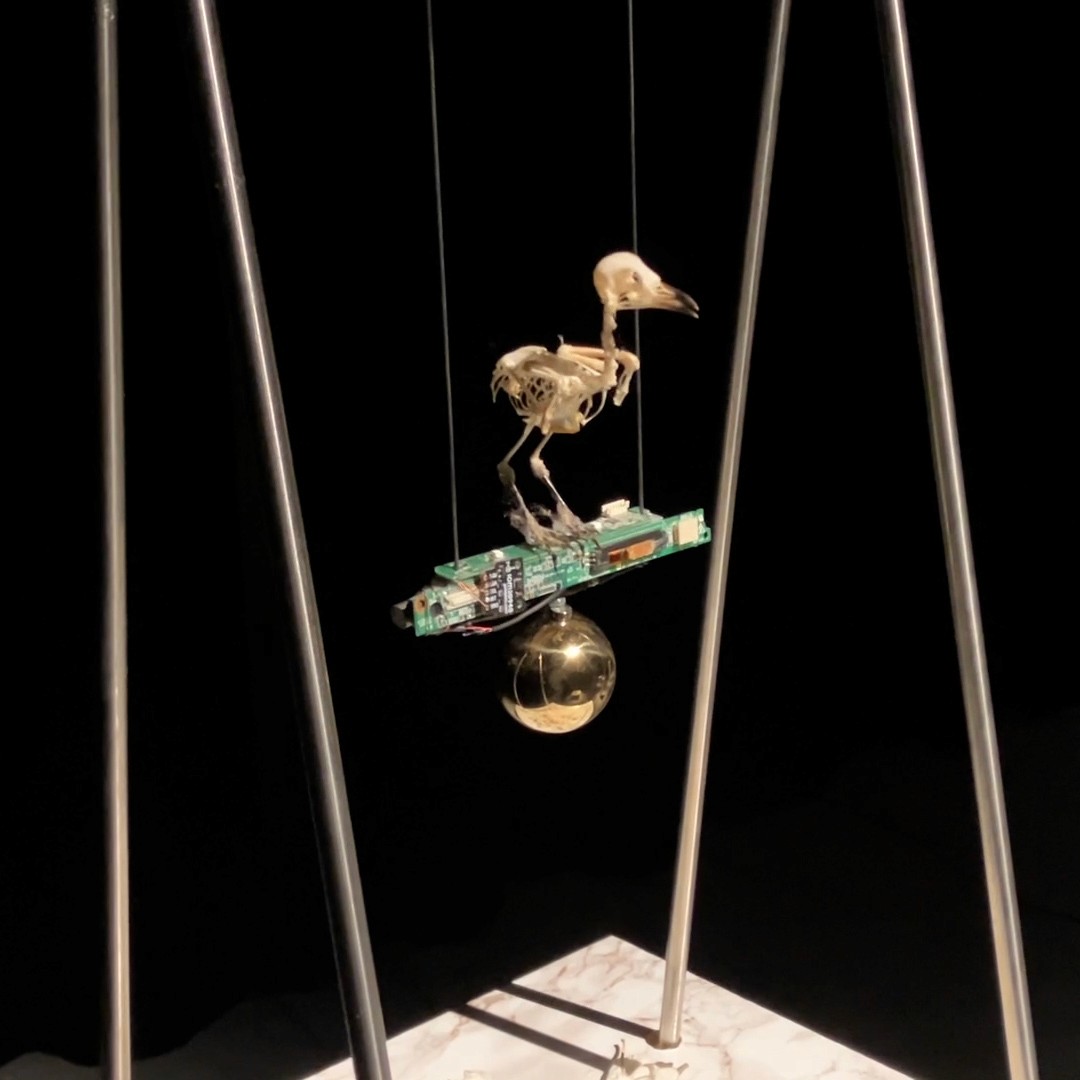
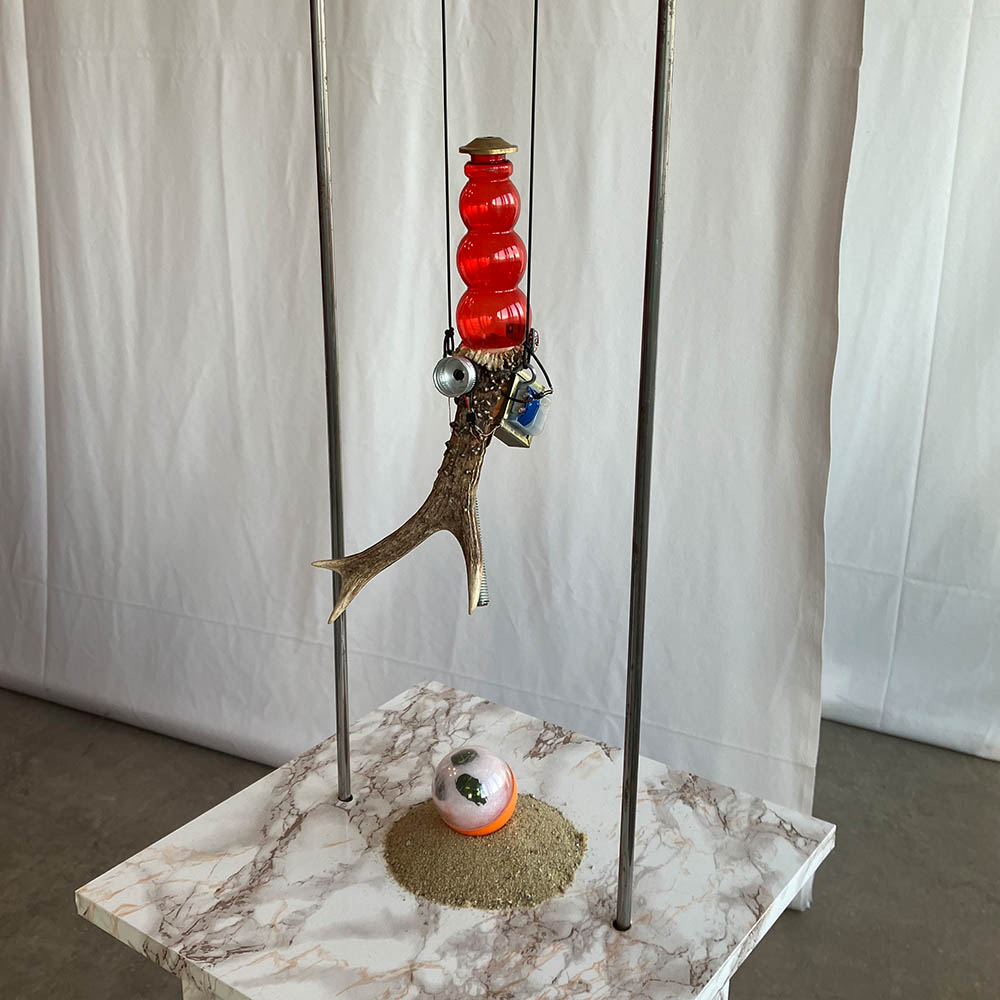
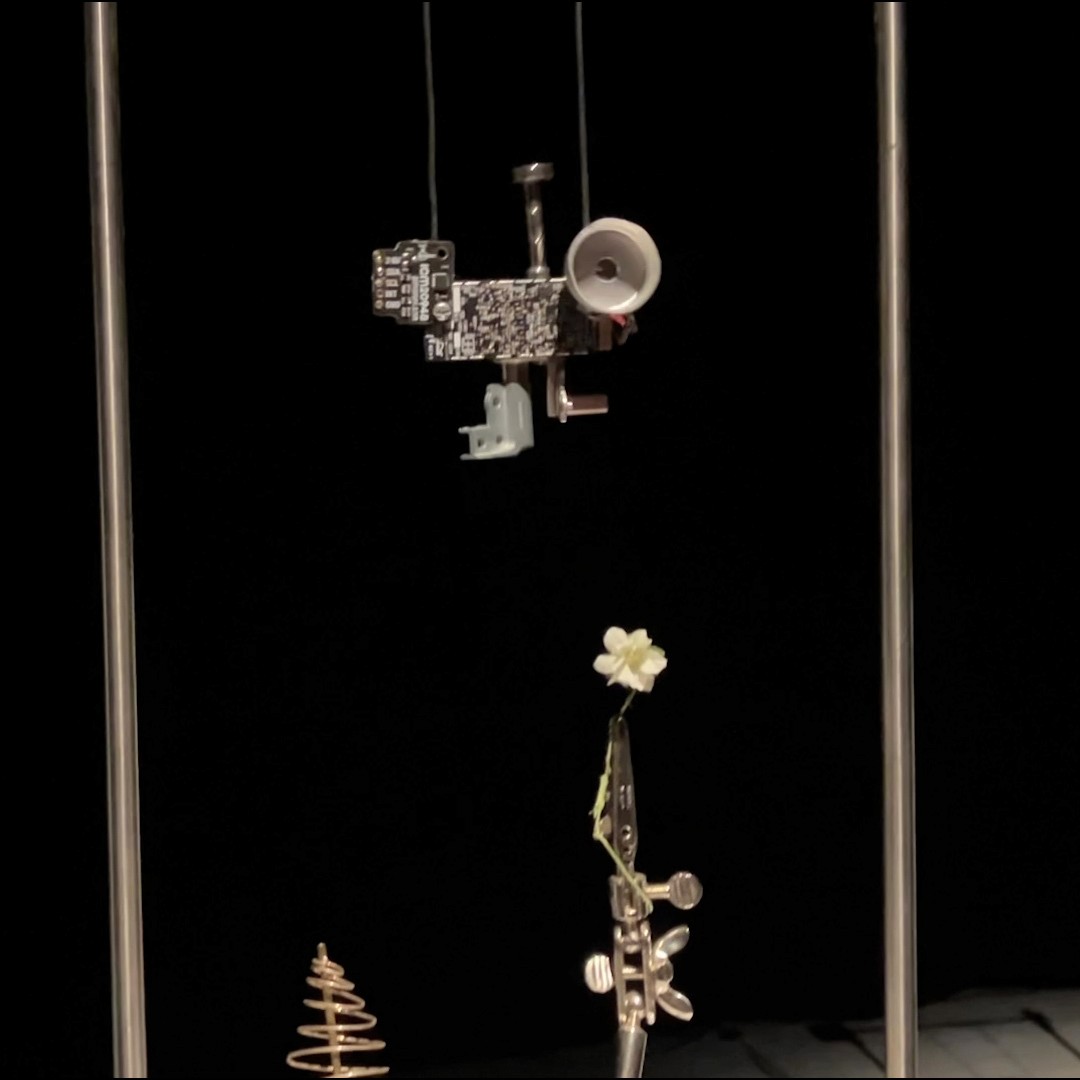
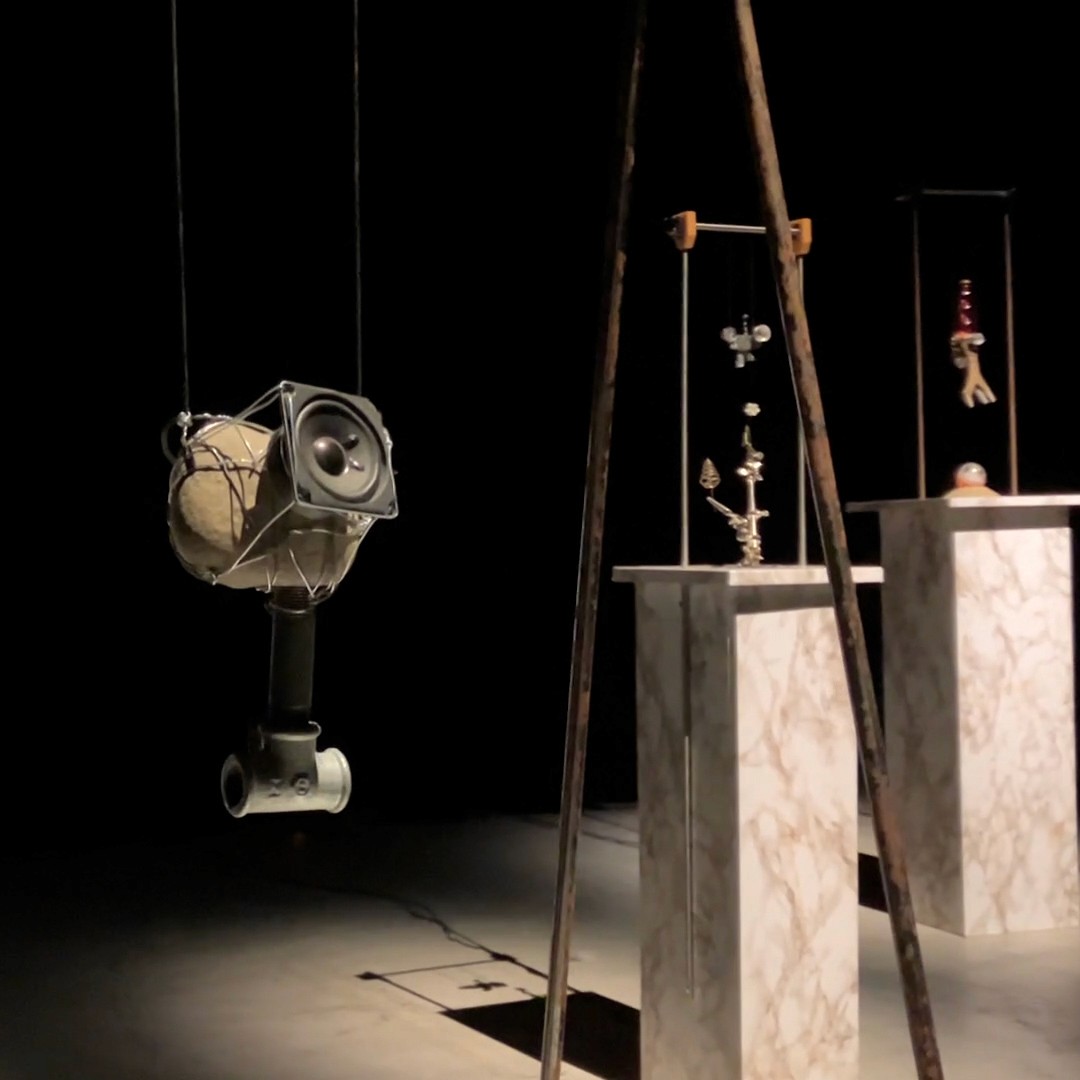
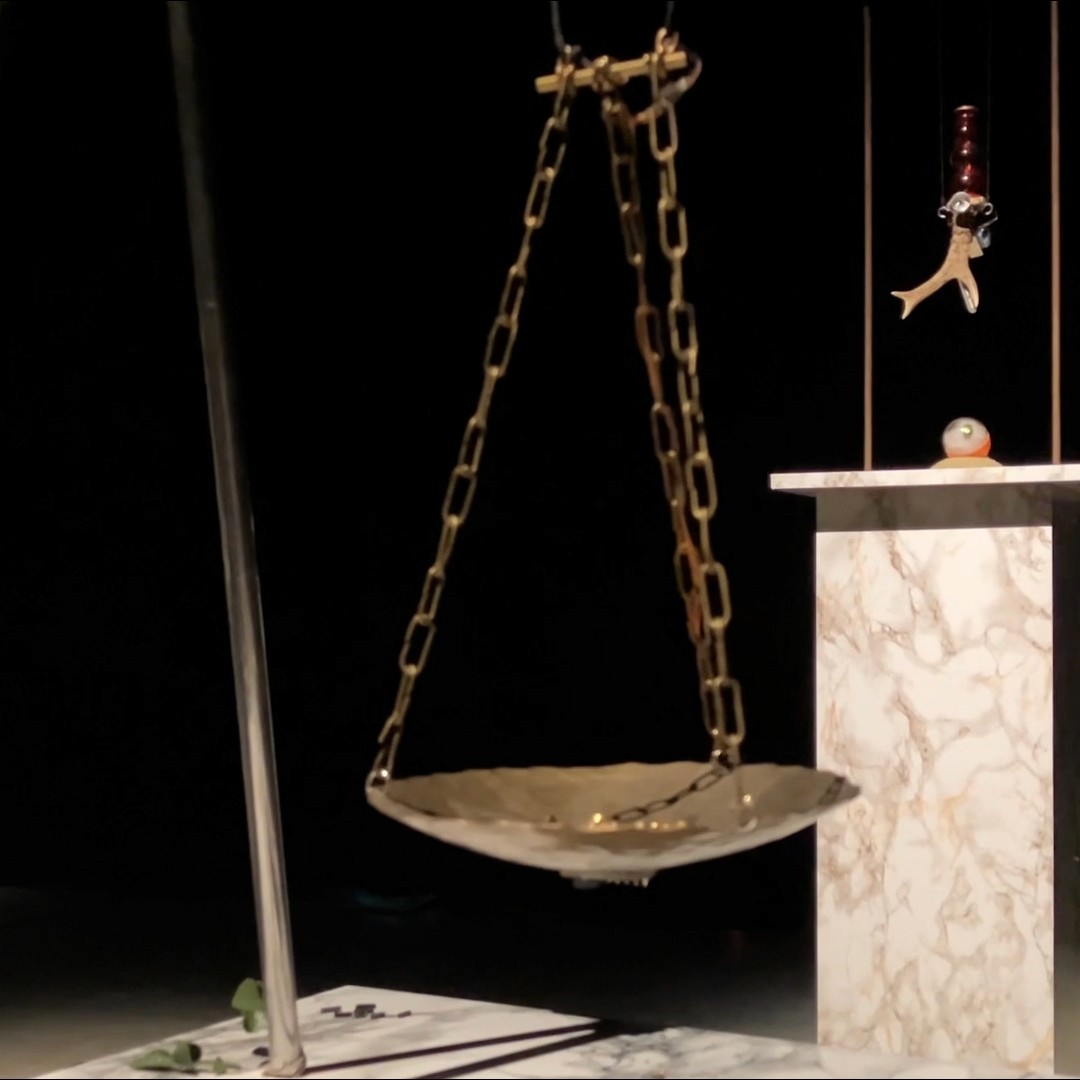
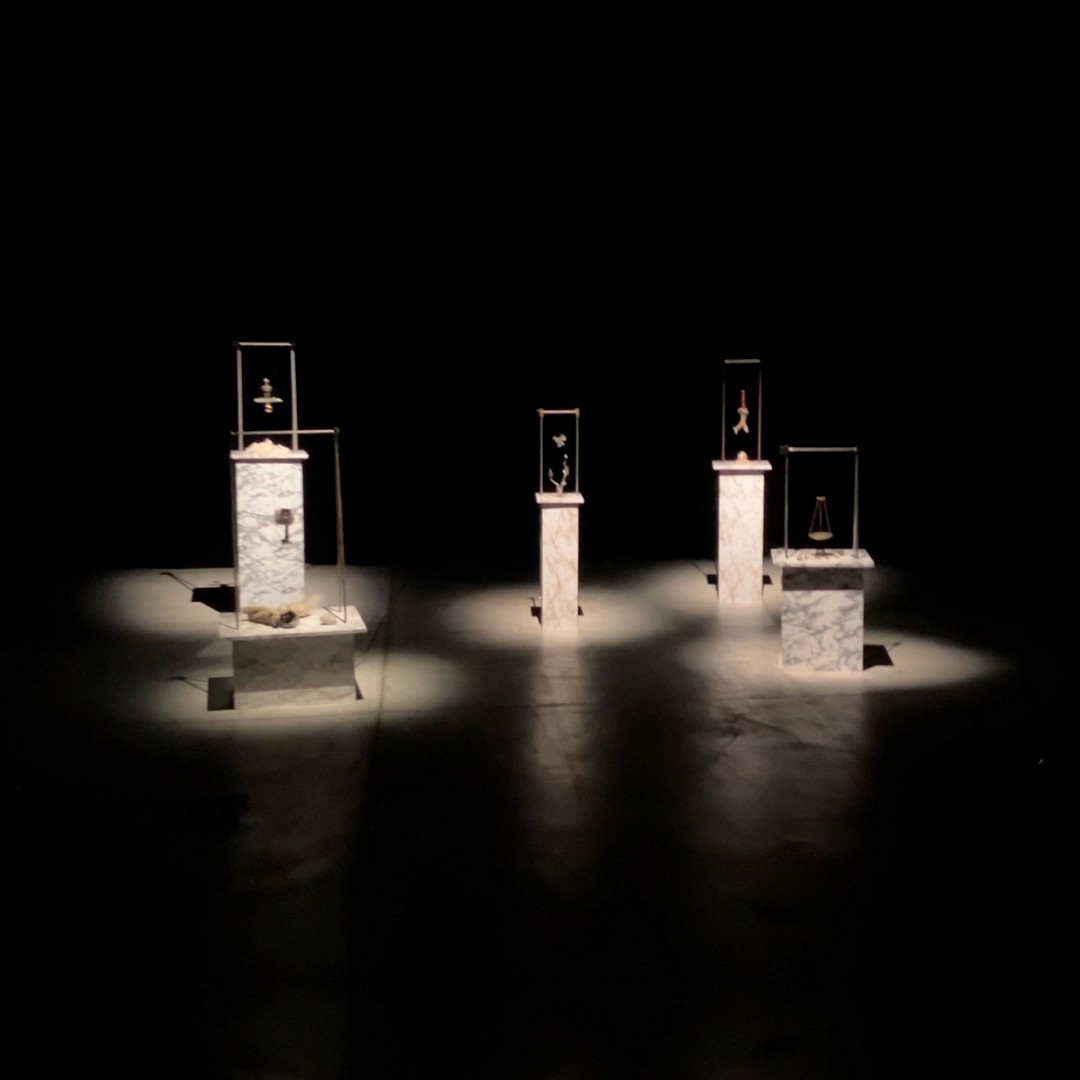
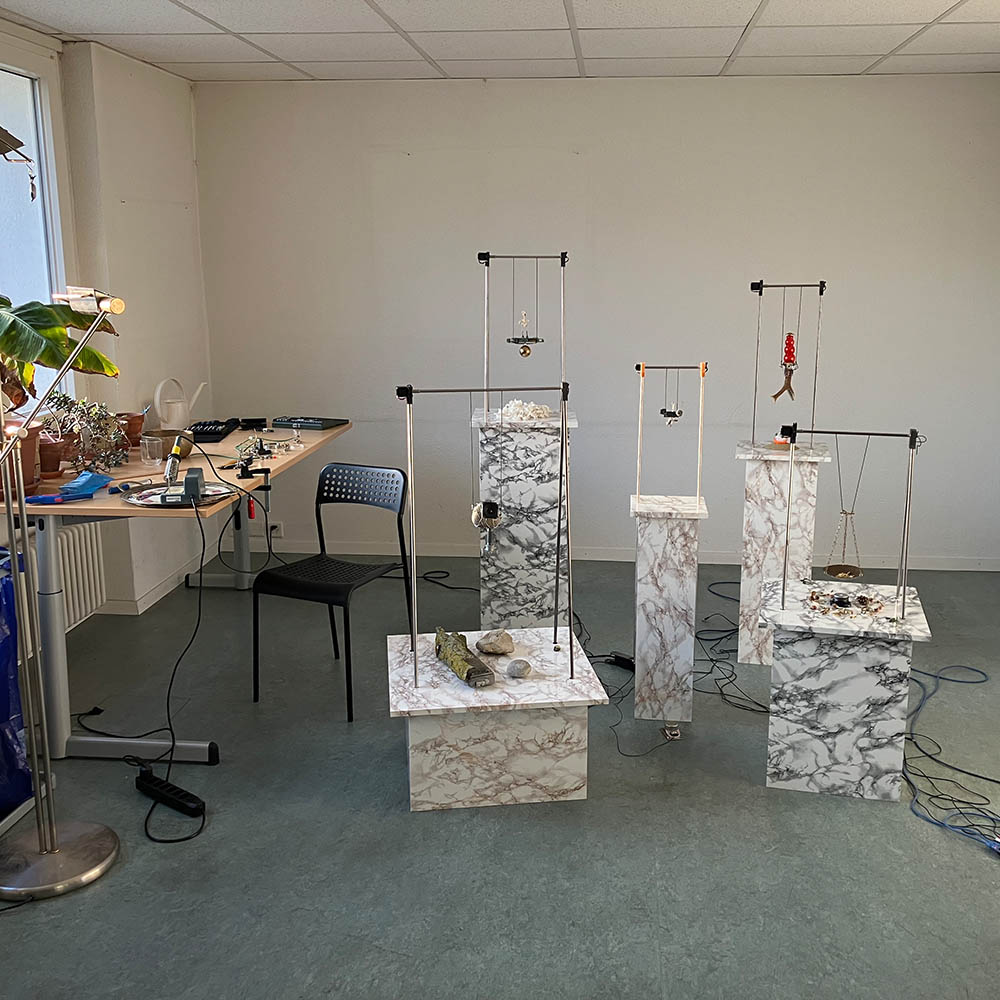
Altar of Lost Things is a kinetic 5-channel sound installation made up of small motors, found objects, organic remains (skeletons, plant remains, dead beetles), discarded electronic components, and sensors. The work is based on a fascination with the interplay of objects, movements, and sounds. It is a collaboration with Maximilian Kriegleder. Consisting of five altars on which objects are suspended as swinging pendulums, the installation creates changing rhythmic patterns and soundscapes.
Sometimes the sounds are close to nature: insect noises, birdsong, or frog croaking. Sometimes they are electronic and mechanical. Sometimes the sound worlds merge, so it is unclear whether the sounds are electronically generated or organic. The sounds are not random, but are the direct result of the oscillations of the objects. Both visually and aurally, the repetitive back-and-forth swinging of the pendulums creates a hypnotic effect. In terms of content, the work deals with various themes—from nature and technology, to transience and transformation, to the question of how these worlds interweave.

The objects are set in motion by the stepper motors while accelerometers attached to the objects register the movement. The movement is then sent to a processor where it generates sound in realtime.

What interests us about pendulums?
The laws of pendulum physics were discovered in the 15th century by Galileo Galilei and are among the cornerstones of scientific description. From a musical perspective, what makes pendulums particularly interesting is their ability to swing in a steady rhythm, independent of the force applied. The tempo of this oscillation is determined solely by the length of the string from which the object hangs (longer strings result in slower rhythm and vis versa).
Using small motion sensors, we convert the pendulums’ movement into sound. Thus, the pendulum installation functions like a primitive, analog drum machine, whose rhythms we can change by adjusting the lengths of the strings. The imprecision of our various pendulums create constantly changing rhythmic patterns with a hypnotic quality. An archaic, physical world is connected with the possibilities of digital sound synthesis.
Our album 'Verlorene Dinge' features pieces we've been playing over the past years. All the sounds are recorded using our sensor objects. For our release we installed a listening lounge inside Kaspar König and Jope Schneiders spacy inflatable balloon sculpture 'C-19 organ'.
- email us for bookings, tech rider, questions etc.
How does it work?
We use up to 18 small sensors (accelorometers / gyroscops) which are simply stuck to our objects with sticky tack. The sensors send the movement data of the objects to our computer via bluetooth, where it is transformed to sound using Ableton and Max4Live. In collaboration with Max Kriegleder we are currently developing
new sensors to extend the functionality further.
In the above video we show an instrument we call the 'harmonic fishingrod'. The gold obect, with a sensor stuck to it, controls the volume of the fishing rod. The angle of the mic stand (it also has a gyroscope stuck to it) defines the pitch.
In 2023 we won an honorary mention at Ars Electronica in the category of 'digital musics & sound art'. We where able to show our performance for a week in the 'Rutschenhalle', a hall full of slides that was used by the Austrian post to sort packages. The jury had this to say about our work:
'In The Queer Art of Failure (2011), Jack Halberstam praises the 'wondrous anarchy of childhood' as offering a stark contrast to structured and disciplined formats of creativity or knowledge. There is something truly reminiscent and nostalgic within the playful innocence of OSZILOT and that is its success. Combining analogue objects and digitizing their sound through gyro sensors, this sonic interpretation is at once extremely satisfying to the ear whilst reanimating our imaginations by giving new meaning to objects which, as “adults,” we might erroneously write off as mundane. We love that the piece invites its audience to come and interact with an orchestra of table chairs, pots, and vases brought to life. Play is always more fun when it’s collective anyway.'